

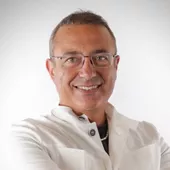

Excellence in implantology, oral surgery, and restorative dentistry
Dr. Massimo Frosecchi is a leading expert in implantology, prosthodontics, and oral surgery. His practice focuses on restoring function and esthetics through dental implants, bone grafting, and guided surgery – offering precise, reliable results even in complex cases. In prosthodontics, he designs crowns, bridges, and implant-supported restorations that combine durability, comfort, and natural appearance. His use of digital planning tools and advanced biomaterials enhances surgical accuracy and supports tissue regeneration, reflecting his dedication to modern, technology-driven dentistry.
A pioneer and thought leader in modern dentistry
Recognized internationally, Dr. Frosecchi stands among Italy’s foremost specialists. After earning his degree in Dentistry and Dental Prosthesis from the University of Florence in 1992, he completed postgraduate training in implantology and pre-prosthetic surgery there, then expanded his expertise at the State University of New York at Buffalo in 1995. This international experience placed him at the forefront of emerging surgical techniques and shaped his global perspective on dentistry as a discipline of shared innovation. His career now bridges clinical excellence, academic leadership, and research dissemination, positioning him as both a practitioner and mentor.
Educator, innovator, and global speaker
Alongside his clinical work in Florence, Dr. Frosecchi teaches implantology and evidence-based dentistry at the University of Genoa and co-directs courses at Universidade Nove de Julho in São Paulo, Brazil. His lectures at international congresses and master courses focus on guided surgery, biomaterials, and immediate loading protocols – topics he conveys with clarity and practical insight. Innovation defines his philosophy: his practice integrates digital diagnostics, computer-guided surgery, and minimally invasive techniques to ensure patients receive the most advanced care available.
Patient-centered care and international Impact
Dr. Frosecchi’s approach centers on trust, transparency, and long-term oral health. His multidisciplinary clinic, Dental Medicine Firenze, brings together specialists in orthodontics, periodontics, endodontics, and restorative dentistry, offering coordinated and comprehensive treatment. Patients highlight the professionalism, modern equipment, and attentive care that reflect his leadership and commitment to excellence. Through his involvement with scientific organizations such as ITI and IAO, he continues to shape best practices in implantology and biomaterials. His enduring influence lies in both the thousands of patients he has treated and the many professionals he has trained – embodying how dentistry can merge science, education, and compassion to improve lives worldwide.
Massimo Frosecchi’s web and social presence
Academic education
- 1992: Graduation in Dentistry and Dental Prosthetics at the University of Florence, Italy.
- 1994: Post-graduate education in “Implantology and pre-prosthetic surgery” at University of Florence, Italy.
- 1995: Course "Advanced Course in Implantology and Bone Graft Harvesting" at New York State University at Buffalo, USA.
Academic positions and educational activities
- 2006-2007: Speaker at post-graduate course in implantology at Universidade Guarulhos, São Paulo, Brazil.
- 2007-2016: Speaker at Master Course of Fixed Prosthesis at University of Florence, Italy (time-out in 2011)
- 2007-2009: Speaker at University degli Studi Gabriele D’Annunzio di Chieti Pescara, Italy.
- 2008: Professor a c. at the same institurion. Speaker in Master Course in Implantology at University of Pisa.
- 2008-2019 co-director of Implantology courses at Universidade Nove de Julho, Sao Paulo, Brazil.
- 2011: Study Club Director ITI Italy for the Toscana.
- . 2011: Active member of International Piezosurgery Academy
- 2012-2014: Speaker at Master course in Piezosurgery at University Federico II, Napoli, Italy.
- 2013 to date: Professor a c. in Implantology and Scientific evidences at University of Genoa, Italy.
Memberships
- 2000: Founder and president of “Il Giglio aggiornarsi a Firenze”, an association of continuing education in Dentistry.
- 2013: Active member of AIOM (Italian Academy of Microscopic Dentistry).
- From 2005: Speaker of the ITI on global level. From 2008 Fellow of the ITI
- From 2018: Active member of IAO (Italian Academy of Osseointegration).
Dr. Frosecchi’s contributions to youTooth
After tooth extraction, the real challenge begins: choosing the right implant timing for the case. This lecture breaks down the decision tree—ridge preservation, late, early, or immediate placement—balancing predictable osseointegration with a truly natural look. Expect prosthetically driven 3D positioning, digital planning, guided workflows, and step-by-step protocols, with a sharp focus on immediate implant restoration.
Guided surgery enables the transfer of planning into surgery with greater accuracy. Furthermore, it offers the possibility of having a temporary restoration before surgery, requiring only minimal adjustment and activation at the end.
Jason® membrane, a stretchable collagen membrane, was introduced by botiss in 2009. In the time since, its excellent handling and biocompatibility, in combination with the extended barrier function, have set a new standard for both larger and smaller augmentation procedures. In the following, three selected clinicians – Prof. Daniel Rothamel, Dr. Michael Kristensen, and Dr. Massimo Frosecchi – discuss the scientific background and indication range of the Jason® membrane, also providing personal recommendations for its application in daily practice.
The treatment plan in this case report included the placing of six BLT implants in the maxilla, followed by full reconstruction of the entire jaw. No complications or adverse situations were observed at any time during the treatment, from the planning to the final prosthetic installation. The patient was extremely satisfied with his new denture. Overall, the treatment required a relatively low number of appointments, with just a single surgical session. An immediate replacement of natural dentition in the upper jaw with an implant-supported full-arch bridge was achieved in a controlled and planned way, minimizing the risks and potential patient discomfort. The patient appreciated the immediate loading approach, since it enabled him to maintain a “fixed teeth” situation and avoid a removable denture stage during the osseointegration period.
This webinar explores the key biological and prosthetic principles that guide successful bone augmentation, with a focus on Guided Bone Regeneration (GBR) and sinus lift procedures. Through practical insights into grafting techniques, graft management, and defect handling, the session equips clinicians to navigate complex clinical situations with confidence. Since no single technique or biomaterial fits all clinical needs, the webinar emphasizes a case-by-case approach—helping participants understand how to choose the most appropriate solution based on defect type and treatment goals. Expect valuable tips and tricks to enhance predictability and optimize outcomes.
Peri-implantitis is an inflammatory disease that affects the mucosa and alveolar bone around dental implants and represents a major biological complication. Furthermore, it is considered a common risk factor for late implant failure. The following clinical case report describes the management of peri-implantitis in two locations and with two complementary approaches in a periodontal patient. Non-surgical periodontal treatment was applied before addressing the peri-implantitis sites. After periodontal improvement of the natural dentition, the two implants affected were treated with two different strategies. In the most severe bone loss site, access to the site, explantation, and regenerative treatment was done. On the other hand, the implant with less severe peri-implant bone loss was treated to stop further bone resorption and obtain a more stable peri-implant soft tissue situation. For these successful approaches, bovine bone substitute granules (Straumann® XenoGraft), porcine dermis matrix (mucoderm® soft tissue graft, botiss®, distributed by Straumann Biomaterials), and enamel matrix derivatives (Straumann® Emdogain®) were used.
This report highlights the importance of combining the Straumann® BLX implant with GBR techniques and soft tissue substitutes in the management of the esthetic zone. By addressing both biological and esthetic challenges, this approach ensures long-term success, delivering functional and visual harmony while enhancing patient satisfaction. Immediate restoration must always be considered a challenging procedure. Implant planning, surgical procedure and prosthetic procedure must be extremely accurate. Optimal primary stability, absence of occlusal lateral forces and good patient compliance can be considered prerequisites for this kind of procedure.
In the following case report, Dr. Frosecchi presents a bimaxillary full-arch treatment utilizing the LOCATOR FIXED® system, highlighting its clinical efficacy and patient-centered advantages. This case report aims to provide insights into the significant benefits of the LOCATOR FIXED® attachment system in addressing the challenges of bimaxillary full-arch rehabilitation. The LOCATOR FIXED® system simplifies procedures for a variety of patients, making things easy not just during the initial prosthetic phase but also in follow-up care. This is especially helpful for those facing age-related cleaning challenges during full-arch rehabilitation. LOCATOR FIXED® system is a practical alternative to screw-retained prostheses, avoiding the need for complex removal procedures for cleaning or for addressing complications. A LOCATOR FIXED® prosthesis can be removed within seconds using the appropriate removal tool.
This lecture is about the decisional tree after tooth extraction. Several options are analyzed to determine the most effective treatment approach. Implant dentistry represents a predictable and successful treatment for partial and full edentulism. After tooth extraction, clinicians are called daily to decide the ideal timing for implant placement in different clinical situations. Ridge preservation, late implant placement, early placement or immediate placement represent the standard options. Each approach has specific advantages and disadvantages that must be evaluated to ensure not just osseointegration, but also a final natural appearance. Tridimensional ideal prosthetically driven implant placement is always mandatory to provide function and esthetics. Digital planning and a computer-guided approach became a standard of care in most implant cases. After scientific and clinical considerations, step by step procedures for every option will be shown. Special attention will be dedicated to immediate implant placement and restoration, considering implant features, biomaterials and prosthetic tools.

The Jason® membrane was introduced by botiss in 2009. Since then, it has set a new standard for any guided bone regeneration procedure. What makes it so special? We have asked Dr. Massimo Frosecchi.

The Jason® membrane was introduced by botiss in 2009. Since then, it has set a new standard for any guided bone regeneration procedure. What makes it so special? We have asked Dr. Massimo Frosecchi.