






 International – English



Guided Full‑Arch Mandibular Rehabilitation Using Four Immediately Loaded Implants with Axiom® X3S System

Dr. Brigitte‑Sabine Kirchmann
Germany
Qualified Specialist in Oral Surgery
- German dental license (Approbation), 2014
- Practicing dentist in Germany since 2014
- Current position at Kowadent (since 2020)
- Clinical experience in multiple practices in Düsseldorf
- Focus on implantology and aesthetic dentistry
- Advanced training in implant procedures, sinus lift, soft tissue management, and digital dentistry (CAD/CAM, CEREC)
Introduction.
Severe periodontal disease frequently results in terminal mandibular dentition, functional impairment, and progressive bone resorption, making implant-supported rehabilitation both biologically and mechanically challenging (1-2). Achieving sufficient primary stability in an atrophic mandible is a critical prerequisite for immediate loading and long-term clinical success (2-3).
Full-arch rehabilitation using four strategically positioned implants to support a fixed prosthesis, while reducing the need for extensive bone grafting procedures, is a widely accepted concept (3-4). When combined with digital planning and guided surgery, this approach allows prosthetically driven implant placement and improved control in anatomically compromised situations (4-5).
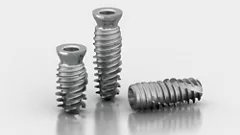
The Axiom® X3S implant system was selected in this case due to its capacity to achieve high primary stability in reduced bone volume and its compatibility with guided surgery and immediate loading protocols. Its macro-design and implant-abutment connection are intended to enhance anchorage in low-density or resorbed bone.
This clinical report presents a guided full-arch mandibular rehabilitation with four implants in a patient with advanced periodontal destruction and significant bone resorption. The objective of this report is to describe a reproducible digital workflow and to evaluate the clinical performance of Axiom® X3S implants in a challenging full-arch immediate loading indication.
Treatment plan.
A 45-year-old female patient presented with pain, impaired mastication, and mobility of the remaining mandibular teeth, associated with severe dental anxiety but no systemic contraindications. She had worn a provisional prosthesis for 20 years following multiple tooth loss, with progressive periodontal deterioration resulting in terminal mandibular dentition. After initially declining implant therapy at her 2025 consultation, she opted for treatment following further clinical progression.
A full-arch mandibular rehabilitation using a guided four-implant immediate loading protocol was planned based on digital diagnostics (intraoral scans, radiographs, and CBCT) and interdisciplinary prosthetic planning. The procedure involved atraumatic tooth extraction, guided implant placement of four Axiom® X3S implants in positions 32, 34, 42, and 44, and immediate loading. Localized posterior bone augmentation was performed where required, followed by placement of multi-unit abutments and preparation for provisional prosthetic restoration.
Initial Situation.
Clinical examination revealed terminal mandibular dentition associated with advanced periodontal disease. The remaining teeth (33 and 43–47) exhibited severe mobility, gingival inflammation with bleeding, marked periodontal attachment loss, and significant discomfort during mastication (Fig 1-3). The patient reported persistent pain and an inability to chew properly. In addition, the gingival tissues showed signs of active infection, and the teeth presented with discoloration and compromised aesthetics.
Radiographic and CBCT evaluation confirmed severe horizontal and vertical bone resorption with advanced periodontal destruction, indicating a poor prognosis (Fig 4). Based on these clinical and radiological findings, the remaining teeth were deemed non-restorable.
Fig. 1–4 — Preoperative assessment.
Terminal mandibular dentition with severe mobility and advanced bone resorption.


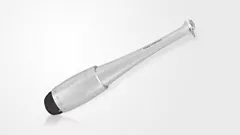
Feel the grip. Master stability.
Discover Anthogyr's new implant solution designed to enhanced anchorage in in demanding clinical situations.
Surgical procedure.
Under local anesthesia, all remaining mandibular teeth were atraumatically extracted, flap raised. Implant osteotomies were then performed using a digitally designed surgical guide to ensure accurate, prosthetically driven positioning (Fig 5-10).
Four Axiom® X3S implants were placed in regions 32, 34, 42, and 44. Adequate primary stability (33N.cm) was achieved in all sites, allowing implementation of an immediate loading protocol (Fig 11-12). Due to localized posterior bone deficiencies, additional bone augmentation was performed in regions 34 and 44 using a xenogenic bone substitute material (Xenogenic bone substitute material).
Following implant placement, multi-unit abutments were installed (Fig 13-14).
Fig. 5–10 — Guided surgical procedure
Atraumatic extractions followed by fully guided, prosthetically driven implant osteotomies.
Fig. 11–12 — Implant placement and primary stability
Four X3S implants placed (32, 34, 42, 44) achieving 33 N.cm primary stability for immediate loading.
Fig. 13–14 — Multi-unit abutments placement
Placement of multi‑unit abutments to support immediate full‑arch restoration.
Fig. 15–18 — Immediate full-arch provisional restoration
Immediate screw-retained provisional prosthesis restoring function and esthetics.
Prosthetic Procedure.
Following implant placement and verification of primary stability, multi-unit abutments were secured and temporary cylinders connected. A prefabricated provisional full-arch prosthesis, designed from the preoperative digital workflow, was then positioned intraorally, adjusted, and screw-retained (Fig 15-18).
This immediate restoration re-established function, aesthetics, and phonetics, allowing rapid return of masticatory ability and improved patient comfort.
Postoperative healing was uneventful, with stable implants and favourable soft tissue response. Follow-up evaluations confirmed satisfactory prosthetic integration and high patient satisfaction, with a notable improvement in overall function and quality of life (Fig 19-21).
Fig. 19–21 — Postoperative outcome
Stable implants with favorable tissue response and functional full‑arch integration.
Final Situation.
At the time of publication, prosthetic rehabilitation is still in progress. Final outcomes will be documented in a future update.
Conclusion.
Immediate loading in full-arch rehabilitation has become a predictable approach when adequate primary stability is achieved. The use of a four-implant full-arch concept enables efficient utilization of available bone while reducing the need for extensive augmentation. In combination with digital planning and guided surgery, it allows precise, prosthetically driven implant placement and enhances overall treatment predictability.
In this case, the integration of digital workflow, guided surgery, and immediate loading facilitated successful rehabilitation of a patient with terminal mandibular dentition and severe periodontal destruction. The Axiom® X3S implant system contributed to achieving the primary stability required for this protocol.
Overall, this approach proved to be a reliable treatment option, delivering predictable functional and aesthetic outcomes while significantly improving the patient’s quality of life.
Clinical Takeway.
Guided surgery combined with Axiom® X3S enables predictable immediate loading in full-arch mandibular cases by achieving reliable primary stability, even in reduced and compromised bone.
References.
Marruganti, C., Paoli, S., & others. (2023). Clinical outcomes of dental implants in patients with and without history of periodontitis: A 20-year prospective study. Journal of Clinical Periodontology. https://onlinelibrary.wiley.com/doi/full/10.1111/jcpe.13716
Lindhe, J., Meyle, J., & Group D of European Workshop on Periodontology. (2023). The influence of history of severe periodontitis on estimated long-term marginal bone level of implants supporting fixed full-arch restorations. Clinical Oral Implants Research. https://pmc.ncbi.nlm.nih.gov/articles/PMC10607884/
Carinci, F., Pezzetti, F., Zeza, B., Pistilli, R., Rubini, C., & others. (2000). Implant-supported fixed prostheses for the rehabilitation of patients with periodontal disease. Clinical Oral Implants Research, 11(6), 548–557. https://pubmed.ncbi.nlm.nih.gov/11799702/
Barao, V. A. R., Assunção, W. G., Tabata, L. F., Gomes, E. A., de Arruda, N. O., & Sanchez-Ayala, A. (2021). Complete digital workflow for mandibular full-arch implant rehabilitation: A clinical report. The Journal of Prosthetic Dentistry, 126(1), 1–5. https://pubmed.ncbi.nlm.nih.gov/33811713/
Shah, N. A., et al. (2024). Assessment of the effectiveness of digital implant planning and guided surgery in improving implant placement accuracy and prosthetic outcomes compared to conventional freehand techniques. Journal of Population Therapeutics and Clinical Pharmacology. https://jptcp.com/index.php/jptcp/article/view/10040